How Any Team Can Deliver Value Faster (Without More Chaos)
Agility Beyond IT is a contemporary framework that extends agile methodologies beyond traditional IT environments, emphasizing the application of agility principles in various sectors. This approach is significant because it enables organizations to enhance collaboration, increase operational efficiency, and foster innovation across diverse teams, regardless of their technical background. As businesses face rapidly changing market conditions and customer demands, the need for agile practices that prioritize responsiveness and adaptability has become more critical than ever. [1] [2] The framework centers on several core principles, including a customer-centric focus, the embrace of change, iterative learning and improvement, and the empowerment of teams. By prioritizing customer satisfaction through early and continuous delivery of value, organizations can ensure their offerings align with customer needs and expectations. [3] [4] Furthermore, the culture of collaboration and autonomy promoted within agile practices facilitates a more dynamic work environment, enabling teams to navigate complexities and challenges more effectively. [5] [6] However, implementing agility beyond IT is not without its challenges. Organizations often encounter resistance to change, rooted in traditional hierarchies and control-based cultures. To address these barriers, effective strategies such as piloting projects, engaging stakeholders, and fostering a culture of continuous improvement are crucial for successful adoption. [7] [8] Moreover, case studies in sectors like education and healthcare illustrate both the potential and the hurdles of integrating agile methodologies, highlighting the need for tailored approaches that suit specific operational contexts [9] [10] Overall, “Agility Beyond IT” represents a transformative shift in how organizations operate, encouraging a mindset that prioritizes flexibility and responsiveness while navigating the complexities of modern business environments. As industries increasingly recognize the value of agility, the potential for improved performance and customer satisfaction continues to grow. [11] [12]
In complex work, the advantage goes to organizations that learn faster—not those with the prettiest plans.
In brief:
– These ways of working help teams deliver value with fewer late surprises.
– The focus is visibility, fast feedback, and deliberate adjustment—not more meetings.
– Leaders get results when decision-making and priorities support the new way of working.
Start with a simple observation
Many leaders still associate modern ways of working with software teams. That’s understandable—technology groups adopted these ideas early. But the underlying problem they solved exists everywhere: outcomes are uncertain until you start, learn, and adjust.
Whether you lead marketing, operations, HR, finance, sales enablement, or public services, you are likely managing work where priorities shift, constraints change, and assumptions get exposed late. When that happens, the cost of being ‘wrong’ is far higher than the cost of learning early.
What “agile” means in plain language
Think of agility as a management system for complex work. It does three things well:
- Makes work visible so everyone sees the same reality.
- Creates short feedback loops so teams learn before they commit too much time and money.
- Uses that learning to adjust priorities and ways of working—quickly and deliberately.
Why this matters outside technology
Outside IT, the work still has the same patterns that create delays and waste: multiple handoffs, slow approvals, unclear success criteria, and ‘busy’ teams with unpredictable results.
When leaders introduce agility well, the benefits are not theoretical. They show up as faster decision-making, fewer late surprises, and higher confidence because progress is observable.
Where this approach fits particularly well
These ways of working help most when the right answer is discovered, not dictated. Common examples include:
- Marketing experiments and campaigns where customer response is uncertain.
- Operational improvements where root causes are not obvious upfront.
- Hiring and onboarding where bottlenecks hide in handoffs and approvals.
- Procurement and finance processes where cycle time is dominated by waiting.
- Customer support and service delivery where quality and speed compete.
A quick diagnostic: is your work complex enough to need agility?
If you answer ‘yes’ to several of these, a more adaptive approach will usually reduce risk:
- Do priorities change before work is finished?
- Do you discover problems late—near launch, audit, escalation, or customer complaints?
- Do approvals and dependencies dominate the timeline?
- Do stakeholders disagree on what ‘success’ looks like?
- Is your team busy, yet outcomes still unpredictable?
What to demand early (30–60 days)
If you sponsor an agility initiative, avoid vague promises. Demand observable signals:
- A visible view of work and blockers (not filtered through optimistic reporting).
- Regular review of real outcomes (what changed for customers, operations, or the business).
- Fewer things started at once—and more things finished.
- Faster decisions where teams can act without unnecessary escalation.
Principles of Agility Beyond IT
- Customer-Centric Focus
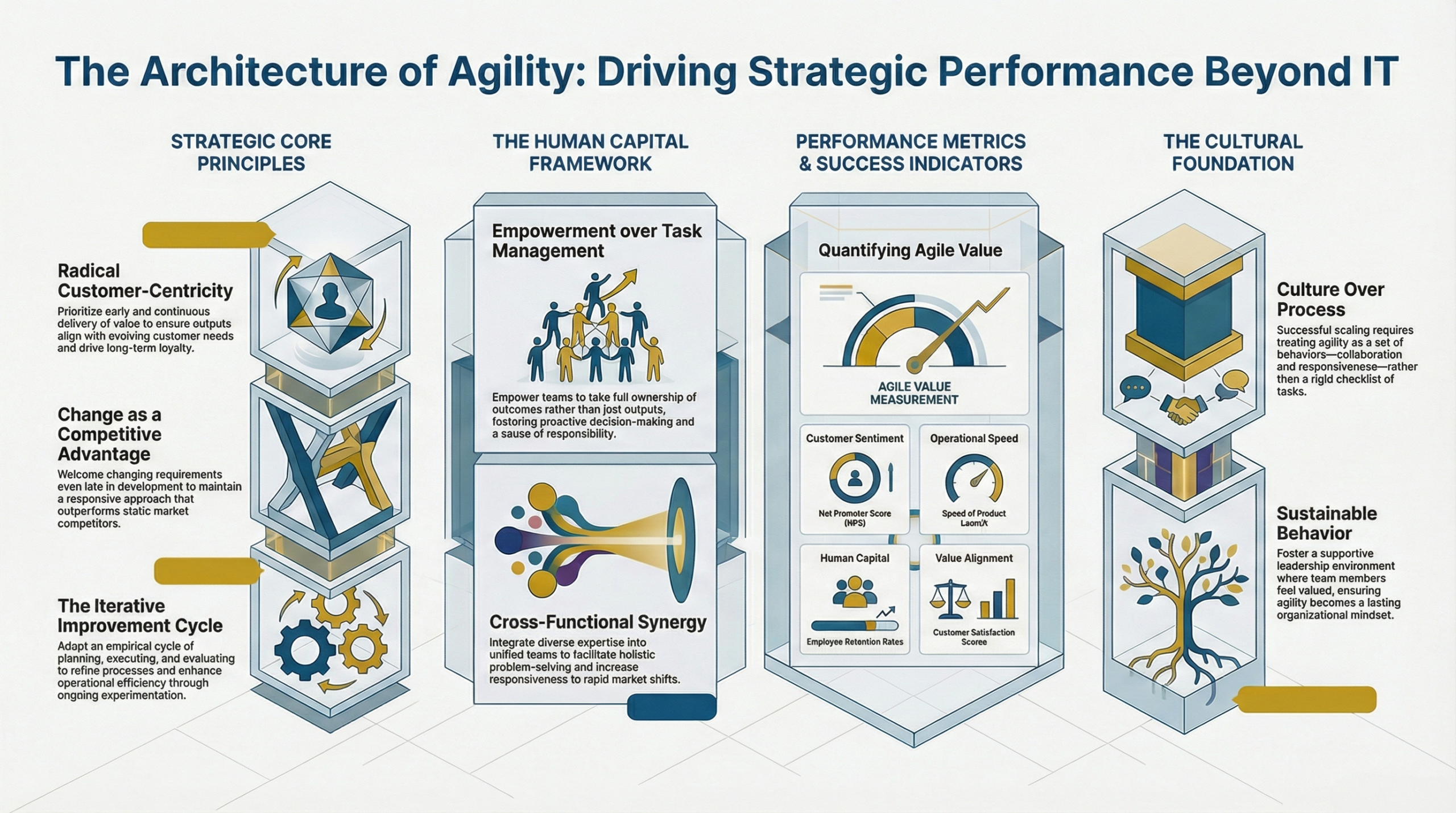
A core principle of agility is prioritizing customer satisfaction through the early and continuous delivery of valuable products or services. Organizations adopting agile methodologies emphasize the importance of aligning their outputs with customer needs, thereby ensuring that their offerings meet expectations and drive customer loyalty [1] [2]. Continuous engagement and feedback from customers are essential for fostering this focus, allowing teams to iterate and adapt based on real-time insights and changing requirements [3].
- Embracing Change
Agility entails welcoming changing requirements, even late in the development process. This flexibility allows organizations to harness change for competitive advantage, facilitating the development of solutions that can adapt to evolving market conditions and customer demands [1]. By maintaining a changeable and responsive approach, teams can better position themselves to meet the needs of their stakeholders.
- Iterative Learning and Improvement
Continuous improvement is fundamental to agile practices, which advocate for ongoing learning and adaptation. This iterative approach encourages teams to experiment, gather feedback, and refine their processes regularly [4]. Agile innovation often follows a cyclical process where teams plan, execute, and evaluate, using empirical findings to influence future actions [2]. Such a mindset is crucial for organizations aiming to enhance their operational efficiency and adaptability.
- Empowerment and Autonomy
Agile principles emphasize the importance of empowering teams to take ownership of outcomes rather than just outputs. This empowerment fosters a sense of responsibility and encourages proactive decision-making within teams [5]. Leadership should focus on creating an environment where team members feel supported and valued, promoting a culture of collaboration and open communication.
- Cross-Functional Collaboration
Building cross-functional teams is vital in non-IT sectors seeking to implement agile methodologies. Such teams bring diverse perspectives and expertise together, facilitating a holistic approach to problem-solving and innovation [6]. Regular collaboration and feedback loops within these teams can enhance overall performance and responsiveness to market changes.
- Metrics for Success
To measure the effectiveness of agile transformations, organizations should track various outcomes, such as employee engagement, customer satisfaction, and operational efficiency. Metrics like Net Promoter Score (NPS), retention rates, and the speed of product launches provide insights into how well teams are delivering value and adapting to customer needs [7] [4]. By continuously monitoring these metrics, organizations can identify areas for improvement and celebrate successes, reinforcing the agile mindset across the team.
- Culture Over Process
Ultimately, fostering an agile culture is more crucial than rigidly adhering to specific processes. Agility should be seen as a behavior that supports delivery rather than a checklist of tasks. Scaling agile effectively involves nurturing a culture that values collaboration, responsiveness, and innovation above all else [5] [3]. This cultural emphasis helps teams navigate the complexities of delivering value in a dynamic environment, making agility a sustainable practice beyond IT.
Challenges and Solutions
Organizations seeking to implement agility beyond IT face a range of challenges, particularly in adapting to the complexities of their environments. One prominent issue is the resistance to change within teams, often rooted in a historical preference for stability over innovation. This resistance can stem from a culture that values detailed planning and predictability, as seen in traditional education systems where adherence to the established order has been the norm for decades [16] [17]. To navigate these challenges, a “Back to Basics” approach can be effective. For instance, a consumer finance company struggling with regulatory compliance adopted this method by involving a senior-level program manager to conduct a comprehensive project review. This initiative aimed to re-establish stakeholder ownership and project governance, thus realigning teams with project objectives and enhancing overall clarity [13]. Additionally, enhancing problem-solving and decision-making skills through the analysis of case studies allows professionals to engage critically with complex scenarios, fostering an environment of continuous learning and adaptation [13] [18]. This practical application of concepts helps teams test their understanding of agile methodologies and adapt to new challenges effectively. Moreover, establishing resilient systems is crucial. Leaders must create an environment that encourages experimentation while maintaining focus on key priorities. This includes using scenario planning to build confidence and practical skills among team members, enabling them to pivot and respond swiftly to new opportunities and risks [11] [5]. Ultimately, organizations that embrace agility can enhance responsiveness, foster innovation, and improve operational efficiency. By investing in agile structures, training, and a supportive culture, they can transform digital disruption into a strategic advantage, thereby delivering value faster and more effectively without increasing chaos [19] [4] [20].
Tools and Techniques
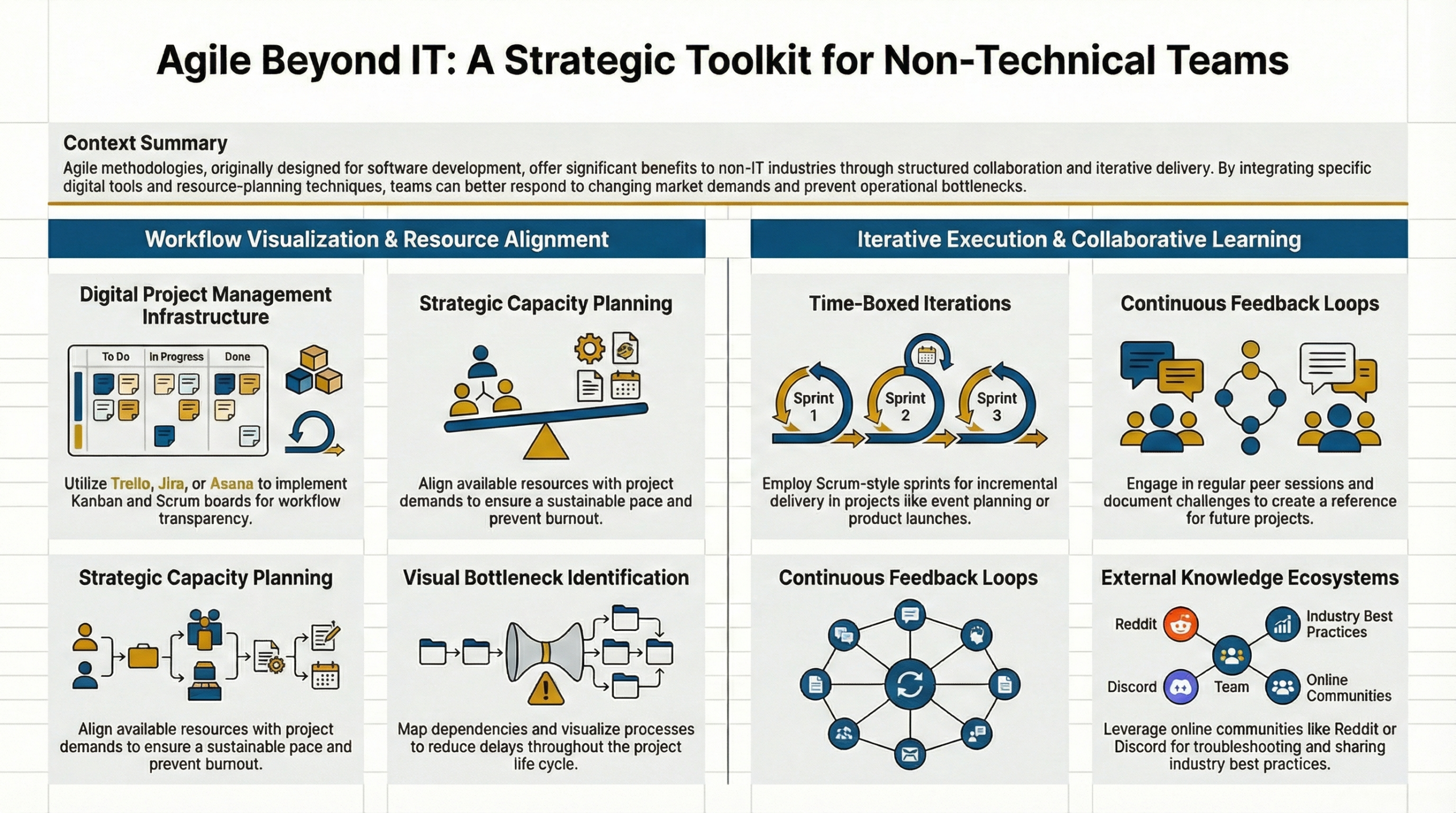
Agile methodologies have proven to be adaptable and beneficial across various industries, extending beyond the traditional software development realm. The following tools and techniques are commonly utilized to enhance project management and collaboration in non-IT teams.
- Project Management Tools
Several digital tools facilitate the implementation of Agile practices, including Trello, Jira, and Asana. These platforms provide functionalities such as kanban boards and scrum boards, which help teams visualize their workflows and track progress effectively. By employing these tools, teams can experience authentic applications commonly used in the IT industry, thereby enhancing their collaboration and productivity [21] [4].
- Iterative Approaches
Agile encourages teams to adopt iterative processes, allowing for incremental delivery of projects. This method not only helps in refining ideas based on feedback but also enables teams to adjust their workload according to their capacity. For instance, Scrum employs time-boxed sprints, which can be beneficial in managing tasks for various types of projects, including event planning and product launches [3] [8] [22].
- Collaborative Practices
Engaging in regular feedback sessions is crucial for continuous improvement. Teams should actively share their work with peers, instructors, or online communities to gain insights and identify areas for enhancement. By documenting their learning journey, including challenges faced and solutions discovered, teams can maintain motivation and create a valuable reference for future projects [23] [6].
- Capacity Planning
Effective capacity planning allows teams to align their resources with project demands, ensuring a sustainable pace of work. This approach minimizes the risk of burnout and enhances the ability to respond to changing circumstances throughout the project life cycle. Visualizing processes and managing dependencies further contribute to reducing bottlenecks and delays, fostering a more efficient workflow [19] [4] [6].
- Community Engagement
Joining online communities such as Reddit or Discord can be invaluable for teams exploring Agile methodologies. These platforms serve as support networks where members can share best practices, troubleshoot issues, and collaborate on solutions, promoting a culture of continuous learning and adaptation [23] [24]. By integrating these tools and techniques, non-IT teams can leverage Agile methodologies to boost their efficiency, foster collaboration, and enhance their ability to respond to changing market demands, ultimately delivering greater value to customers [25] [6].
Future Trends
The landscape of Agile methodologies is continuously evolving, particularly as organizations across various industries seek to enhance their operational efficiency and responsiveness to market changes. Future work in this domain should focus on several key areas to further embed Agile Innovation into organizational practices.
- Documentation and Tool Development
A crucial trend will be the documentation of step-by-step implementations of Agile Innovation, including the challenges organizations face and strategies employed to overcome them. By capturing these experiences, organizations can create a repository of knowledge that will serve as a valuable resource for future Agile implementations. Additionally, there is a need to develop off-the-shelf tools, including software solutions, that can facilitate training and support the practical implementation of Agile methodologies in diverse contexts [2].
- Comparative Studies and Sustainability
Another important trend involves comparative studies that evaluate the outcomes of Agile Innovation against traditional quality improvement methods. Such studies could shed light on the effectiveness and advantages of Agile approaches, providing empirical evidence that organizations can leverage to justify their transition to Agile practices. Furthermore, examining the sustainability of Agile Innovation as an organizational practice over time will be critical. Understanding which factors contribute to long-term success will aid organizations in fostering a culture of continuous improvement and adaptability [2].
- Theoretical Development
As Agile practices mature, there is an increasing demand for new theories and methodologies that incorporate elements of Agility, innovation, participatory design, and customer-centeredness, especially in sectors such as healthcare. These new frameworks will be essential in navigating the complexities of modern service delivery and ensuring that organizations can effectively respond to evolving customer needs and market conditions [2] [26].
- Impact on Non-IT Industries
The application of Agile methodologies is also expected to expand beyond IT, revolutionizing how organizations in non-IT sectors operate, collaborate, and innovate. By embracing Agile principles, these industries can achieve greater responsiveness and efficiency, thereby meeting changing market demands and enhancing customer satisfaction. This trend is particularly evident in healthcare, where Agile practices can significantly improve service delivery and patient outcomes [19] [6].
- Agility as a Core Capability
Finally, cultivating agility as a core organizational capability will become imperative for businesses seeking to thrive in an increasingly volatile environment. Companies that have adopted Agile methods have reported enhanced operational efficiency and improved customer satisfaction, underscoring the value of agility in achieving competitive advantage [19] [27]. Leaders will need to invest in creating agile structures and a culture that prioritizes flexibility, innovation, and responsiveness across all levels of the organization [19].
References
- [1]: Agile Principles from a Non-IT Industry Standpoint
- [2]: innovating in complex adaptive systems is an everyday process, not …
- [3]: Agile for non-tech teams: How Agile for non-software projects works
- [4]: 9 Business Outcomes to Focus on for a Successful … – Agile Velocity
- [5]: Agile principles in healthcare IT: How speed and focus beat size and …
- [6]: How to Implement Agile Practices in Non-IT Industries
- [7]: How to design a successful Agile team structure – Nakisa
- [8]: Incorporating Agile Project Management in Non-Tech Industries
- [9]: How to Overcome 15 Common Challenges Introducing Agile
- [10]: Agile in Healthcare – Agility in Learning
- [11]: Why Schools Struggle With Implementation. And How They Can Do …
- [12]: Agile methodology in education: how to implement it online – SMOWL
- [13]: Top Agile Case Studies: Examples Across Various Industires
- [14]: Case studies – Agile EDU
- [15]: Agile EDU – Project outcomes – European Schoolnet
- [16]: Agile Schools: How Technology Saves Education (Just Not the Way …
- [17]: 8 Agile Development Challenges and How to Overcome Them
- [18]: Learning Agility: What It Is, Examples & How to Assess It – Harver
- [19]: Agility as a Strategic Enabler: Unpacking the Digital Transformation …
- [20]: Agile Methodology Explained | U of M CCAPS
- [21]: Agile methodologies in the classroom: Empowering students to take …
- [22]: Agile Beyond Technology: Case Studies in Non-Program Industries
- [23]: Best Agile Tools for Software Engineering Students to Learn
- [24]: How to introduce non technical team to Agile? – Reddit
- [25]: Agile Simplified For Non-Software Teams
- [26]: Top 8 Industries That Are Nailing With Agile Adoption
- [27]: Agile Methodology: Lessons to Learn from Non-Tech Businesses
How Any Team Can Deliver Value Faster (Without More Chaos)
Agility Beyond IT is a contemporary framework that extends agile methodologies beyond traditional IT environments, emphasizing the application of agility principles in various sectors. This approach is significant because it enables organizations to enhance collaboration, increase operational efficiency, and foster innovation across diverse teams, regardless of their technical background. As businesses face rapidly changing market conditions and customer demands, the need for agile practices that prioritize responsiveness and adaptability has become more critical than ever. [1] [2] The framework centers on several core principles, including a customer-centric focus, the embrace of change, iterative learning and improvement, and the empowerment of teams. By prioritizing customer satisfaction through early and continuous delivery of value, organizations can ensure their offerings align with customer needs and expectations. [3] [4] Furthermore, the culture of collaboration and autonomy promoted within agile practices facilitates a more dynamic work environment, enabling teams to navigate complexities and challenges more effectively. [5] [6] However, implementing agility beyond IT is not without its challenges. Organizations often encounter resistance to change, rooted in traditional hierarchies and control-based cultures. To address these barriers, effective strategies such as piloting projects, engaging stakeholders, and fostering a culture of continuous improvement are crucial for successful adoption. [7] [8] Moreover, case studies in sectors like education and healthcare illustrate both the potential and the hurdles of integrating agile methodologies, highlighting the need for tailored approaches that suit specific operational contexts [9] [10] Overall, “Agility Beyond IT” represents a transformative shift in how organizations operate, encouraging a mindset that prioritizes flexibility and responsiveness while navigating the complexities of modern business environments. As industries increasingly recognize the value of agility, the potential for improved performance and customer satisfaction continues to grow. [11] [12]
In complex work, the advantage goes to organizations that learn faster—not those with the prettiest plans.
In brief:
– These ways of working help teams deliver value with fewer late surprises.
– The focus is visibility, fast feedback, and deliberate adjustment—not more meetings.
– Leaders get results when decision-making and priorities support the new way of working.
Start with a simple observation
Many leaders still associate modern ways of working with software teams. That’s understandable—technology groups adopted these ideas early. But the underlying problem they solved exists everywhere: outcomes are uncertain until you start, learn, and adjust.
Whether you lead marketing, operations, HR, finance, sales enablement, or public services, you are likely managing work where priorities shift, constraints change, and assumptions get exposed late. When that happens, the cost of being ‘wrong’ is far higher than the cost of learning early.
What “agile” means in plain language
Think of agility as a management system for complex work. It does three things well:
- Makes work visible so everyone sees the same reality.
- Creates short feedback loops so teams learn before they commit too much time and money.
- Uses that learning to adjust priorities and ways of working—quickly and deliberately.
Why this matters outside technology
Outside IT, the work still has the same patterns that create delays and waste: multiple handoffs, slow approvals, unclear success criteria, and ‘busy’ teams with unpredictable results.
When leaders introduce agility well, the benefits are not theoretical. They show up as faster decision-making, fewer late surprises, and higher confidence because progress is observable.
Where this approach fits particularly well
These ways of working help most when the right answer is discovered, not dictated. Common examples include:
- Marketing experiments and campaigns where customer response is uncertain.
- Operational improvements where root causes are not obvious upfront.
- Hiring and onboarding where bottlenecks hide in handoffs and approvals.
- Procurement and finance processes where cycle time is dominated by waiting.
- Customer support and service delivery where quality and speed compete.
A quick diagnostic: is your work complex enough to need agility?
If you answer ‘yes’ to several of these, a more adaptive approach will usually reduce risk:
- Do priorities change before work is finished?
- Do you discover problems late—near launch, audit, escalation, or customer complaints?
- Do approvals and dependencies dominate the timeline?
- Do stakeholders disagree on what ‘success’ looks like?
- Is your team busy, yet outcomes still unpredictable?
What to demand early (30–60 days)
If you sponsor an agility initiative, avoid vague promises. Demand observable signals:
- A visible view of work and blockers (not filtered through optimistic reporting).
- Regular review of real outcomes (what changed for customers, operations, or the business).
- Fewer things started at once—and more things finished.
- Faster decisions where teams can act without unnecessary escalation.
Principles of Agility Beyond IT
- Customer-Centric Focus
A core principle of agility is prioritizing customer satisfaction through the early and continuous delivery of valuable products or services. Organizations adopting agile methodologies emphasize the importance of aligning their outputs with customer needs, thereby ensuring that their offerings meet expectations and drive customer loyalty [1] [2]. Continuous engagement and feedback from customers are essential for fostering this focus, allowing teams to iterate and adapt based on real-time insights and changing requirements [3].
- Embracing Change
Agility entails welcoming changing requirements, even late in the development process. This flexibility allows organizations to harness change for competitive advantage, facilitating the development of solutions that can adapt to evolving market conditions and customer demands [1]. By maintaining a changeable and responsive approach, teams can better position themselves to meet the needs of their stakeholders.
- Iterative Learning and Improvement
Continuous improvement is fundamental to agile practices, which advocate for ongoing learning and adaptation. This iterative approach encourages teams to experiment, gather feedback, and refine their processes regularly [4]. Agile innovation often follows a cyclical process where teams plan, execute, and evaluate, using empirical findings to influence future actions [2]. Such a mindset is crucial for organizations aiming to enhance their operational efficiency and adaptability.
- Empowerment and Autonomy
Agile principles emphasize the importance of empowering teams to take ownership of outcomes rather than just outputs. This empowerment fosters a sense of responsibility and encourages proactive decision-making within teams [5]. Leadership should focus on creating an environment where team members feel supported and valued, promoting a culture of collaboration and open communication.
- Cross-Functional Collaboration
Building cross-functional teams is vital in non-IT sectors seeking to implement agile methodologies. Such teams bring diverse perspectives and expertise together, facilitating a holistic approach to problem-solving and innovation [6]. Regular collaboration and feedback loops within these teams can enhance overall performance and responsiveness to market changes.
- Metrics for Success
To measure the effectiveness of agile transformations, organizations should track various outcomes, such as employee engagement, customer satisfaction, and operational efficiency. Metrics like Net Promoter Score (NPS), retention rates, and the speed of product launches provide insights into how well teams are delivering value and adapting to customer needs [7] [4]. By continuously monitoring these metrics, organizations can identify areas for improvement and celebrate successes, reinforcing the agile mindset across the team.
- Culture Over Process
Ultimately, fostering an agile culture is more crucial than rigidly adhering to specific processes. Agility should be seen as a behavior that supports delivery rather than a checklist of tasks. Scaling agile effectively involves nurturing a culture that values collaboration, responsiveness, and innovation above all else [5] [3]. This cultural emphasis helps teams navigate the complexities of delivering value in a dynamic environment, making agility a sustainable practice beyond IT.
Challenges and Solutions
Organizations seeking to implement agility beyond IT face a range of challenges, particularly in adapting to the complexities of their environments. One prominent issue is the resistance to change within teams, often rooted in a historical preference for stability over innovation. This resistance can stem from a culture that values detailed planning and predictability, as seen in traditional education systems where adherence to the established order has been the norm for decades [16] [17]. To navigate these challenges, a “Back to Basics” approach can be effective. For instance, a consumer finance company struggling with regulatory compliance adopted this method by involving a senior-level program manager to conduct a comprehensive project review. This initiative aimed to re-establish stakeholder ownership and project governance, thus realigning teams with project objectives and enhancing overall clarity [13]. Additionally, enhancing problem-solving and decision-making skills through the analysis of case studies allows professionals to engage critically with complex scenarios, fostering an environment of continuous learning and adaptation [13] [18]. This practical application of concepts helps teams test their understanding of agile methodologies and adapt to new challenges effectively. Moreover, establishing resilient systems is crucial. Leaders must create an environment that encourages experimentation while maintaining focus on key priorities. This includes using scenario planning to build confidence and practical skills among team members, enabling them to pivot and respond swiftly to new opportunities and risks [11] [5]. Ultimately, organizations that embrace agility can enhance responsiveness, foster innovation, and improve operational efficiency. By investing in agile structures, training, and a supportive culture, they can transform digital disruption into a strategic advantage, thereby delivering value faster and more effectively without increasing chaos [19] [4] [20].
Tools and Techniques
Agile methodologies have proven to be adaptable and beneficial across various industries, extending beyond the traditional software development realm. The following tools and techniques are commonly utilized to enhance project management and collaboration in non-IT teams.
- Project Management Tools
Several digital tools facilitate the implementation of Agile practices, including Trello, Jira, and Asana. These platforms provide functionalities such as kanban boards and scrum boards, which help teams visualize their workflows and track progress effectively. By employing these tools, teams can experience authentic applications commonly used in the IT industry, thereby enhancing their collaboration and productivity [21] [4].
- Iterative Approaches
Agile encourages teams to adopt iterative processes, allowing for incremental delivery of projects. This method not only helps in refining ideas based on feedback but also enables teams to adjust their workload according to their capacity. For instance, Scrum employs time-boxed sprints, which can be beneficial in managing tasks for various types of projects, including event planning and product launches [3] [8] [22].
- Collaborative Practices
Engaging in regular feedback sessions is crucial for continuous improvement. Teams should actively share their work with peers, instructors, or online communities to gain insights and identify areas for enhancement. By documenting their learning journey, including challenges faced and solutions discovered, teams can maintain motivation and create a valuable reference for future projects [23] [6].
- Capacity Planning
Effective capacity planning allows teams to align their resources with project demands, ensuring a sustainable pace of work. This approach minimizes the risk of burnout and enhances the ability to respond to changing circumstances throughout the project life cycle. Visualizing processes and managing dependencies further contribute to reducing bottlenecks and delays, fostering a more efficient workflow [19] [4] [6].
- Community Engagement
Joining online communities such as Reddit or Discord can be invaluable for teams exploring Agile methodologies. These platforms serve as support networks where members can share best practices, troubleshoot issues, and collaborate on solutions, promoting a culture of continuous learning and adaptation [23] [24]. By integrating these tools and techniques, non-IT teams can leverage Agile methodologies to boost their efficiency, foster collaboration, and enhance their ability to respond to changing market demands, ultimately delivering greater value to customers [25] [6].
Future Trends
The landscape of Agile methodologies is continuously evolving, particularly as organizations across various industries seek to enhance their operational efficiency and responsiveness to market changes. Future work in this domain should focus on several key areas to further embed Agile Innovation into organizational practices.
- Documentation and Tool Development
A crucial trend will be the documentation of step-by-step implementations of Agile Innovation, including the challenges organizations face and strategies employed to overcome them. By capturing these experiences, organizations can create a repository of knowledge that will serve as a valuable resource for future Agile implementations. Additionally, there is a need to develop off-the-shelf tools, including software solutions, that can facilitate training and support the practical implementation of Agile methodologies in diverse contexts [2].
- Comparative Studies and Sustainability
Another important trend involves comparative studies that evaluate the outcomes of Agile Innovation against traditional quality improvement methods. Such studies could shed light on the effectiveness and advantages of Agile approaches, providing empirical evidence that organizations can leverage to justify their transition to Agile practices. Furthermore, examining the sustainability of Agile Innovation as an organizational practice over time will be critical. Understanding which factors contribute to long-term success will aid organizations in fostering a culture of continuous improvement and adaptability [2].
- Theoretical Development
As Agile practices mature, there is an increasing demand for new theories and methodologies that incorporate elements of Agility, innovation, participatory design, and customer-centeredness, especially in sectors such as healthcare. These new frameworks will be essential in navigating the complexities of modern service delivery and ensuring that organizations can effectively respond to evolving customer needs and market conditions [2] [26].
- Impact on Non-IT Industries
The application of Agile methodologies is also expected to expand beyond IT, revolutionizing how organizations in non-IT sectors operate, collaborate, and innovate. By embracing Agile principles, these industries can achieve greater responsiveness and efficiency, thereby meeting changing market demands and enhancing customer satisfaction. This trend is particularly evident in healthcare, where Agile practices can significantly improve service delivery and patient outcomes [19] [6].
- Agility as a Core Capability
Finally, cultivating agility as a core organizational capability will become imperative for businesses seeking to thrive in an increasingly volatile environment. Companies that have adopted Agile methods have reported enhanced operational efficiency and improved customer satisfaction, underscoring the value of agility in achieving competitive advantage [19] [27]. Leaders will need to invest in creating agile structures and a culture that prioritizes flexibility, innovation, and responsiveness across all levels of the organization [19].
References
- [1]: Agile Principles from a Non-IT Industry Standpoint
- [2]: innovating in complex adaptive systems is an everyday process, not …
- [3]: Agile for non-tech teams: How Agile for non-software projects works
- [4]: 9 Business Outcomes to Focus on for a Successful … – Agile Velocity
- [5]: Agile principles in healthcare IT: How speed and focus beat size and …
- [6]: How to Implement Agile Practices in Non-IT Industries
- [7]: How to design a successful Agile team structure – Nakisa
- [8]: Incorporating Agile Project Management in Non-Tech Industries
- [9]: How to Overcome 15 Common Challenges Introducing Agile
- [10]: Agile in Healthcare – Agility in Learning
- [11]: Why Schools Struggle With Implementation. And How They Can Do …
- [12]: Agile methodology in education: how to implement it online – SMOWL
- [13]: Top Agile Case Studies: Examples Across Various Industires
- [14]: Case studies – Agile EDU
- [15]: Agile EDU – Project outcomes – European Schoolnet
- [16]: Agile Schools: How Technology Saves Education (Just Not the Way …
- [17]: 8 Agile Development Challenges and How to Overcome Them
- [18]: Learning Agility: What It Is, Examples & How to Assess It – Harver
- [19]: Agility as a Strategic Enabler: Unpacking the Digital Transformation …
- [20]: Agile Methodology Explained | U of M CCAPS
- [21]: Agile methodologies in the classroom: Empowering students to take …
- [22]: Agile Beyond Technology: Case Studies in Non-Program Industries
- [23]: Best Agile Tools for Software Engineering Students to Learn
- [24]: How to introduce non technical team to Agile? – Reddit
- [25]: Agile Simplified For Non-Software Teams
- [26]: Top 8 Industries That Are Nailing With Agile Adoption
- [27]: Agile Methodology: Lessons to Learn from Non-Tech Businesses
Meet The Author
Meet The Author

Scrum Master / Agile Coach at BASF, focused on fostering agile work cultures in enterprise environments—balancing disciplined IT service governance (ITIL) with outcome-driven delivery. Background spans Scrum Mastery, service delivery, disaster recovery, and technical project leadership. ITIL 4 Foundation | PSPO I.
Scrum Master / Agile Coach at BASF, focused on fostering agile work cultures in enterprise environments—balancing disciplined IT service governance (ITIL) with outcome-driven delivery. Background spans Scrum Mastery, service delivery, disaster recovery, and technical project leadership. ITIL 4 Foundation | PSPO I.
Averroa Principal
Professional Affiliations: BASF