Microservices economics is where many enterprise migrations either earn trust or lose it. The architecture may be “modern”, but the bill, the latency, and the on call load often move in the wrong direction first. That is not a surprise. It is the default outcome when you increase the number of deployable units, duplicate data, add telemetry, and run legacy and new in parallel.
Microservices economics is where many enterprise migrations either earn trust or lose it. The architecture may be “modern”, but the bill, the latency, and the on call load often move in the wrong direction first. That is not a surprise. It is the default outcome when you increase the number of deployable units, duplicate data, add telemetry, and run legacy and new in parallel.
Insights
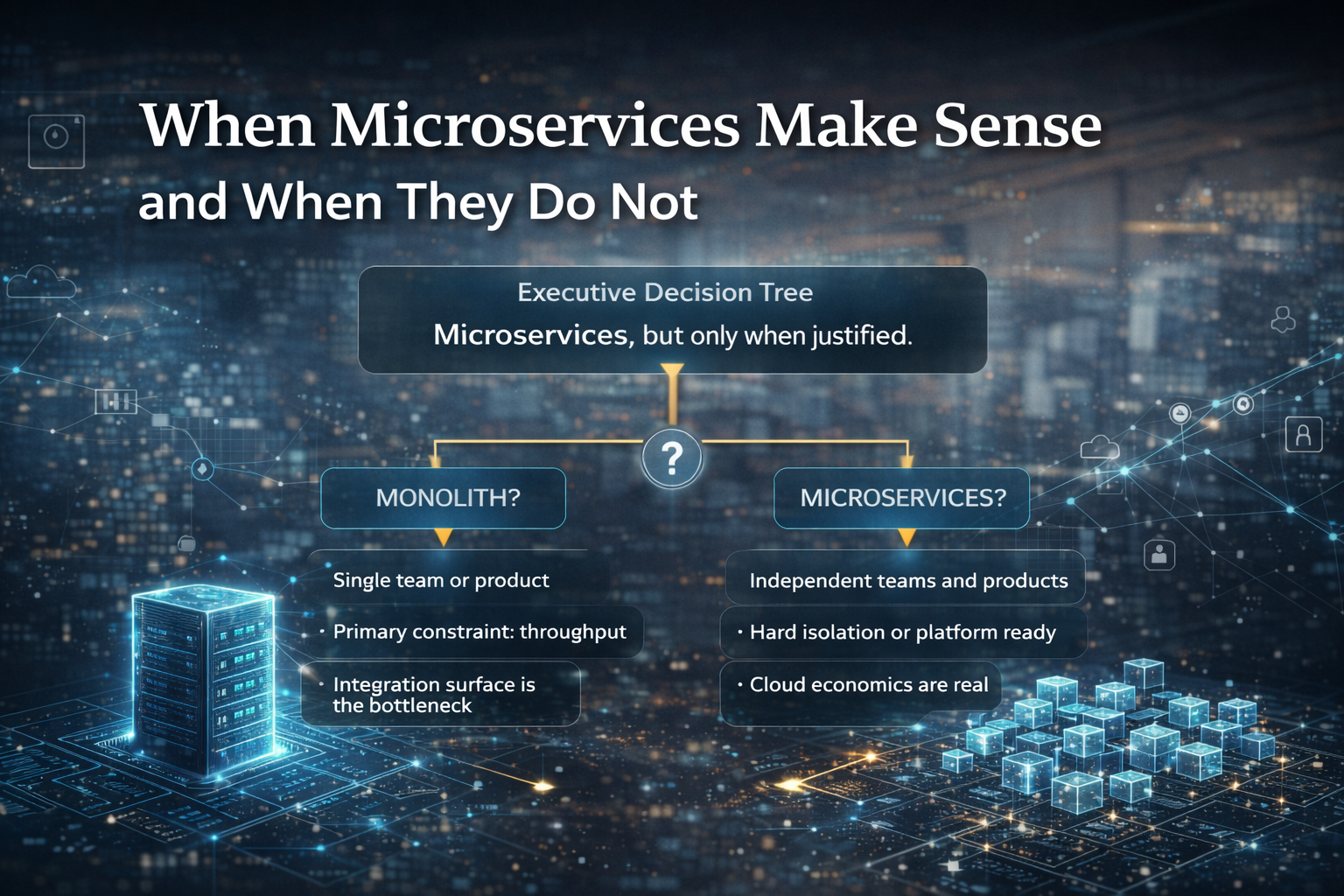
“Move to microservices” has become a default recommendation in many enterprise roadmaps. In practice, the monolith vs microservices decision is not a style choice. It is a capital allocation decision with operational consequences.
“Move to microservices” has become a default recommendation in many enterprise roadmaps. In practice, the monolith vs microservices decision is not a style choice. It is a capital allocation decision with operational consequences.

Most microservices programmes fail before the first service is extracted. The root cause is not the code. It is missing microservices prerequisites across delivery, ownership, and operational control. The market has moved to cloud native at scale, but readiness is uneven.
Most microservices programmes fail before the first service is extracted. The root cause is not the code. It is missing microservices prerequisites across delivery, ownership, and operational control. The market has moved to cloud native at scale, but readiness is uneven.

A decade ago, “microservices” was a specialist conversation. Today it is board relevant because the delivery and risk envelope has changed. Cloud native adoption is now mainstream in Europe, while adoption in the Middle East and Africa is accelerating from a lower base. In the CNCF Annual Survey 2024, 92% of European respondents report at least some cloud native application development and deployment, compared with 66% in the Middle East and Africa.
A decade ago, “microservices” was a specialist conversation. Today it is board relevant because the delivery and risk envelope has changed. Cloud native adoption is now mainstream in Europe, while adoption in the Middle East and Africa is accelerating from a lower base. In the CNCF Annual Survey 2024, 92% of European respondents report at least some cloud native application development and deployment, compared with 66% in the Middle East and Africa.

A pragmatic, enterprise grade guide to migrating from monoliths to microservices. Decision criteria, prerequisites, Strangler Fig migration, service boundaries, data consistency, operations, cost economics, and long term governance.
A pragmatic, enterprise grade guide to migrating from monoliths to microservices. Decision criteria, prerequisites, Strangler Fig migration, service boundaries, data consistency, operations, cost economics, and long term governance.

Executives don’t make decisions from static slide packs anymore. Markets move daily, teams ship weekly, and risks propagate across vendors in hours. Yet many PMOs still email monthly “status packs” stitched from spreadsheets. By the time those decks hit the steering committee, they’re history. Real-time portfolio dashboards change the game. They c [...]
Executives don’t make decisions from static slide packs anymore. Markets move daily, teams ship weekly, and risks propagate across vendors in hours. Yet many PMOs still email monthly “status packs” stitched from spreadsheets. By the time those decks [...]

Programmes are moving faster than your data can keep up. New AI tools appear weekly, teams spin up apps to get work done, and decisions must be made today, not next quarter. The risk: leaders decide on stale, inconsistent, or opaque data. Lightweight data governance fixes this without slowing delivery. It’s not a committee; it’s a small set of cont [...]
Programmes are moving faster than your data can keep up. New AI tools appear weekly, teams spin up apps to get work done, and decisions must be made today, not next quarter. The risk: leaders decide on stale, inconsistent, or opaque data. Lightweight [...]